
When the head got back from Apex Automotive Engineering, 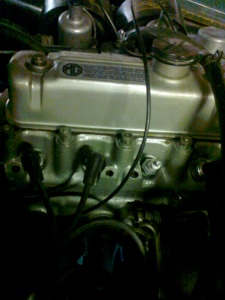 the air injection ports were all plugged with carbon deposits. At first this didn't bug me because this is just part of the emissions system and not critical to the function of the car.
However, as it often happens as time goes on, things that don't work nag on my conscience until I do something about it. The air injection ports are drilled into the spark plug side of the cylinder head of engines originally equipped with an air injection system (12CJ engines at least). The bores are threaded and steel double flared tubing is inserted in these ports in order to seal against the air injection manifold.
These tubes are about 1.5 inches in length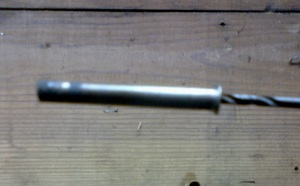 and may become stuck inside the head, however in trying to clean the ports out, they may get stuck to the tool you are cleaning with. I have tried removing them using drywall screws, but these don't get enough grip on them to make any difference. Hot tanking doesn't seem to hurt them, but it may loosen them up enough to be removed. They are made of stainless steel.
Now on to the process…
A lot of controversy surrounds the fear of getting the inside of the engine dirty, so what I am about to suggest may disturb you. Believe it or not this is exactly the method described in the Complete Official 1275cc Sprite/Midget 1967-1974 (a reprinted compillation of factory manuals). The only difference is that a hand drill is recommended. If ever this causes damage I will report it immediately. Anyhow, I suggest taking an electric drill, and a 1/8" drill bit, setting the drill bit to go not much deeper than 1.5" plus the depth of the threaded portion of the port.
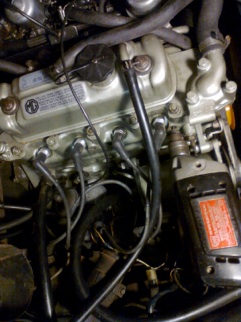
Now carefully drill out the gunk. It is messy so if you like, you can use a shop vac to suck up the dust if you have one handy. The manual mentioned above recommends blowing compressed air into the ports to help clear it of the carbon. After the first pass with the smaller bit, move up to a larger bit. The internal bore of the tubing is roughly the same size as that of the air injection manifold, but the point is to only bore out the dirt, not the metal.
You can test to see how successful you were by starting the car up. If the ports are clear, then some exhaust gas will blow out the injection port. I did this with the engine cold and with the ports clear, there was a louder exhaust note, with a loud pop or bang for each cylinder coming from each injection port, and a moderate puff of gas from each port. It isn't firey hot or anything when the engine is cold, but I wouldn't know how it is when the engine is hot.
Once the ports are clear, do your best to clean up the threads and the flares and everything before reinstalling the manifold. Because the flare fittings on the manifold commonly freeze to the manifold tubing making removal impossible without destroying it, I recommend coating the fitting and with Anti-Seize along and lubricate the tubing with the same so that it moves freely before installation. Anti-Seize is rated to 1500º F. That means the air injection manifold and the cylinder head would burn off their paint and glow a dull cherry red before the Anti-Seize burns off. Since that never happens (engine temp rarely exceeds 230º F and never gets beyond 500º F without damage), i wouldn't worry about that.
A final note. None of this can be done without removing the air injection manifold and the air intake hose for the heater box. Injection ports on cylinders 2,3, and 4 can be cleaned in this way with the air pump in place, but to clean the port on cylinder 1 you have to remove the air injection pump as well.
-Last updated 02/03/2012