
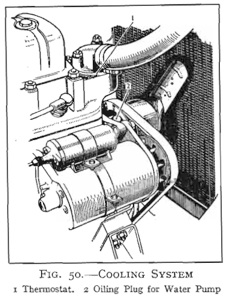
The cooling system on A-Series engined Spridgets (1958-1974) was developed from the Austin A30/A35 and changed little by the end of A-series spridget production in about 1974. The illustrations are from from the Austin Motor Co and were drawn up for repair manuals for the A35.
The internal combustion engine is a wonderful invention. It uses readily available fuel, and turns most of the fuels chemical energy into mechanical energy. Unfortunately no engine is 100% efficient, and some of the chemical energy will be unusable by the engine. This wasted energy is heat. Heat is to some extent a useful thing. If the engine is too cold, the carburettors can't mix the air with the fuel as well as it can when the engine is nice and warm. In winter months the heat from the engine can keep us warm too. The problem is that if the heat is not removed from the engine, it will cause problems. Valves and pistons can melt. Sometimes an engine can even seize up. Thats why a cooling system is so important.
The cooling system in any sprite our midget uses water to move heat out of the engine and into a radiator where heat is lost to the surrounding air. Normally water boils at 212º F (at sea level, the boiling point is lower than this at higher altitudes), but the system in your car is pressurized as the temperature rises and the coolant expands. The boiling point increases with pressure so in theory, the water in a closed system (made of infinitely strong material) would never boil. The problem is that in reality none of the car's parts are infinitely strong, so the pressure would eventually reach a point where components (such as the radiator, heater core, the hoses, gaskets, and even the engine block) fail.
This problem is solved in a few ways. First of all there is always an expansion tank (either built into the radiator or placed near the radiator) to handle some of the expansion. Second there is a pressure relief valve (the cap to the expansion tank). Third the radiator itself limits expansion by cooling the water. The boiling point of the coolant is determined by the pressure rating of the radiator cap or the expansion tank cap. On all spridgets up through around the middle of 1275cc production, this cap was rated at 7 psi giving a boiling point of about 225º F. Later models had caps that were rated at 15 psi giving a boiling point of 249º F. Generally each pound per square inch raises the boiling point by 2.48º F.
If the cooling system removes too much heat from the engine, we run into some problems (including those already described). What is needed is a way to prevent the engine from getting to cold. Thats what the thermostat does. It sets a minimum temperature for the coolant. When the engine gets too cold, it prevents coolant from circulating through the radiator. When the engine gets warm enough, it opens and allows coolant to flow through the radiator again. Thermostats come in several temperature settings, but 190º F is recommended for later cars by the Haynes manual, and early cars were originally fitted with one that opened somewhere between 158º and 167º.
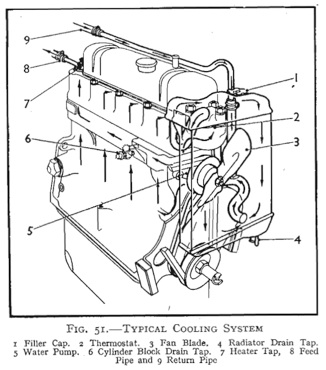
In order for liquid coolant to work well it has to circulate. There are two ways that this is accomplished. First there is convection. As the water is heated by the engine it rises. As it is cooled by the radiator it falls. many cars made in the early 20th century relied on this principle alone. To help the water along, a water pump is fitted. The water circulates as shown in the diagram at left. Cross flow radiator equipped cars circulate water im much the same pattern, with the exception that the water in the radiator flows across and down rather than just straight down. Power is transmitted to the water pump by a v-belt. Early water pumps can be lubricated. Later ones are sealed. The pulley hub on the water pump also makes a convenient place to mount a fan. The fan helps move air through the radiator.
Pure water is one of the best coolants known to man, but it does have some potentially hazardous properties. First of all it expands when it freezes. this can destroy an engine and cause it to crack. Second, water is an excellent solvent. This contributes to corrosion. Antifreeze helps solve both problems by lowering the freezing point, and reducing corrosion. However pure antifreeze is not as good at cooling the engine as water is, so usually a mixture of the two is used to get the best of both.