
The following was a Champion Spark Plug Ad that was featured in the June 1960 Issue of Sports Cars illustrated. I include it in the tech section because it offers a decent introduction to the topic even if it doesn't make any recommendations specific to spridgets. The info may or may not be out of date.

In competition-where victory often hinges on a split second-you need the best possible spark plug performance. And that means matching spark plugs "a s closely as possible to your engine - and to the many factors that affect combustion tem-perature. Now Champion racing engineers tell you how to do this important job. . .
How important is selecting the right spark plug for a racing engine? Indianapolis drivers and mechanics, for example, consider it so important that they usually spend several days selecting, testing and checking spark plugs to tune their engines for best performance. What they are seeking is the most effective spark plug "heat range." If the "heat range" isn't right - power is lost.
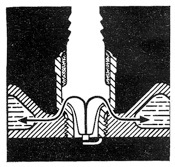
"Heat range" is one of the main factors governing spark plug performance under various conditions. The term "heat range" simply refers to the classification of spark plugs according to their ability to transfer heat from the firing end of the spark plug to the cooling system of the engine.
A plug that transfers heat away from the firing end slowly, so that the temperature of the firing end remains relatively hot, is called a "hot plug." (A "hot plug" does not produce a "hotter" spark.)
A plug that transfers heat away from the firing end rapidly, so that the firing end stays relatively cool, (compared to a "hot plug") , is called a "cold plug."
Usually there are several different heat ranges of spark plugs for any particular engine. What you want is a plug that is neither too "hot" nor too "cold" for the conditions affecting the engine. (A plug "just right" under one set of conditions may be too "cold," or too "hot ," under other conditions. )
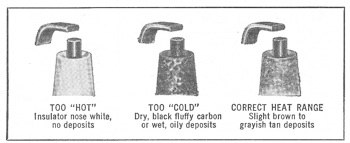
If the plug is too "cold," deposits build up on the insulator nose. These deposits bleed away voltage and can cause a plug to misfire. In severe cases, the plug may not fire at all.
If, however, a plug is too "hot" for the existing conditions, you may encounter preignition. This means that the glowing tip of the insulator ignites the fuel charge before the plug actually sparks. This wastes power, and, in most cases, will cause severe engine damage.
The general rule on selecting heat range is this: the lower the combustion chamber temperatures, the "hotter" the plug should be. As conditions cause combustion chamber temperatures to rise, a "colder" plug is needed.
There are at least nine factors that have some effect on those temperatures:
- COMPRESSION RATIO. The higher the compression ratio, the higher the combustion chamber temperature - and the "colder" the plug should be.
- FUELS AND FUEL BLENDS. Fuel blends that have special power-producing additives result in higher temperatures and have a lower preignition temperature, and thus demand a "colder" plug.
- CARBURETION. A leaner fuel/air mixture tends to increase temperatures. The leaner the mixture, the "colder" the plug should be.
- IGNITION TIMING. In normal spark advance range, advancing timing increases combustion temperatures, requiring a "colder" plug.
- GEAR RATIOS. Higher gear ratios tend to lug an engine. This subjects spark plugs to higher temperatures, calls for a "colder" plug.
- ATMOSPHERIC PRESSURE AND ALTITUDE. Higher pressures (at lower altitudes) tend to lean out fuel mixture, demanding a "colder" plug. Higher altitudes (lower pressures) call for a "hotter" plug.
- SUPERCHARGING. Supercharging increases effective compression ratio, resulting in increased combustion chamber pressures and temperatures, requiring a "colder" plug.
- TYPE OF COMPETITION. In a drag race you are only on the throttle for a few seconds. The combustion chambers do not have a chance to build up nearly as much heat as they would in a 100-mile sports car race, for example. Thus, with other conditions equal, a car being prepared for a drag race would take a "hotter" plug than the same car being prepared for a long run.
- MANIFOLD DESIGN. This can be a complicating factor. Poor manifold design may cause poor fuel distribution, creating different mixtures in different cylinders. This results in different temperatures in the various cylinders and should be corrected.
Before you try selecting the right heat range for racing, your car must be properly tuned. And, of course, before you can go to a "hotter" or "colder" plug, you need a starting point. You will find it in the "size chart" that your Champion dealer has. This Champion chart gives the recommended "average" spark plug heat range for ordinary use of your engine, not for the extreme conditions of competition.
Suppose the spark plug recommended by the chart is a J-8. For competition, start with a plug one or two steps colder J-7 or J-B), depending on your appraisal of the conditions affecting your engine.
Here's a simple tip for recognizing a "hotter" or "colder" type. Think of the Champion numbering system as a thermometer. The higher the number, the "hotter" the plug. A J-11 is "hotter" than a J-8, but "colder" than a J-12, for instance.
The next step is to install a set of Champions of the selected heat range for a trial run. Then "read" the plugs' firing ends to see if you need to go a bit "hotter" or "colder."
Here's how to set up the plugs for a reading. If you're going to use the engine for drag competition, make a regular competition-type run. Then cut off the ignition as you cross the line - at peak power. Pull the plugs out there. Do NOT drive back near the starting line or you will wipe out the indications you're looking for. (We'll tell you what to look for in just a moment.)
If you are going into distance competition, make a run for two laps, going as fast as the course will permit. Then quickly shut off the ignition at full power and disengage the clutch. Pull the plugs without doing any more driving.
After a test run, if the insulator nose of the spark plug shows slight brown to greyish tan deposits, you have the correct heat range.
If the insulator nose has accumulated ether dry, black fluffy carbon deposits or wet, oily deposits, the plug is too "cold." Try a "hotter" plug.
Remember-you want a spark plug that is "hot" enough to keep excessive deposits from forming and causing misfire, yet "cold" enough to avoid the danger of going into preignition, which causes power loss and can damage the engine.
And remember- there's a Champion Spark Plug in the heat range that's right for your engine - and your kind of driving. That's one reason Champion is the speed world's favorite spark plug.
