
The following is excerpted from the 1976 British Leyland dealer training manual (AID # S1033). Download this section here if you like. 1975BLTrnngMnlWhlAlignmt.pdf
PREFACE
The information contained in this booklet is provided as an easy reference guide for technicians. More detailed information is available in the appropriate Workshop Manual.
FAMILIARIZATION
Before we can discuss the aligning of any vehicle, we must first be familiar with the angles involved. Basically we are dealing with the measuring of four angles, three of which are normally adjustable:
Caster
Camber
Toe
Toe Out On Turns (Nonadjustable)
Wheel alignment is simply the accurate measurement of these angles and the necessary adjustment to revert them to manufacturers' tolerances. There are four basic steps to alignment:
Diagnosis
Measuring of Angles
Correction of Angles
Road Test
When we talk alignment, we must be accurate. Many of your adjustments must be within a 1/40 or a 1/116 of an inch. Therefore, we need the simplest, most accurate form of alignment. Most front end equipment on the market today is both simple and accurate. Thorough familiarization with your equipment is a must if you expect to do a worthwhile job. Many manufacturers are willing to provide trained personnel in order to instruct the technician in the use of such equipment. After the equipment is familiar to you, you can put it to use. Talk to your customer about his problem and, if possible, road test the vehicle. These steps, along wit a visual examination of all parts (to check for excess wear), will give you a good knowledge of the car's condition.
VEHICLE HEIGHT
NOTE: Before the setting of any angle, the vehicle height- should be inspected and adjusted if necessary.
CHECKING ANGLES-CAMBER
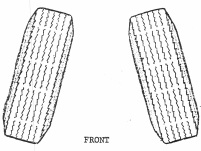
The first angle to be checked is camber. Camber is the term used to describe the inward or outward tilt of the wheels. Positive camber exists when the top of the wheel is tilted outwards. Excessive positive camber causes tire wear on the outer edges. Excessive positive camber on one side will cause the wheeIs to pull to that side.
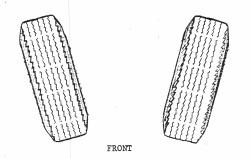
Negative camber is when the top of the wheels are tilted inward. Negative camber causes tire wear on the inside of the tire tread.
CASTER
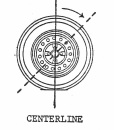
Caster is the term used to describe the leaning, either forward or backward, of the ball joint or king pin centerline. With the top line leaning towards the rear, this is positive caster.
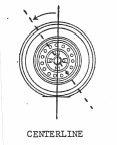
If the ball joint or king pin centerline is leaning forward at the top, then this is known as negative caster.
TOE MEASUREMENTS
Toe (Toe In) means the weels are slightly closer in the front than in the back when the vehicle is stationary. Incorrect toe is the greatest cause of tire wear. The toe readings should be taken only after your caster and camber have been checked and, if necessary, corrected.
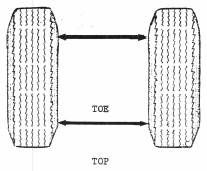
TOE OUT ON TURNS
Toe out on turns is ~ nonadjustable angle which should be checked if the front end is suspected of being damaged. When a front end is set to correct specification! and is in good working condition, toe out on turns can be assumed to be satisfactory. When making a turn (as illustrated), the inside wheel must, turn at a tighter angle than that of the outside wheel.

KING PIN INCLINATION
This is the amount of deviation from straight up and down (measured right to left) that the king pin or ball joint centerline is inclined (not normally adjustable).
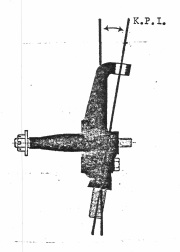
TIRES
Once a vehicle alignment has been carried out completely, then tire condition and balance must be checked. If it is deemed necessary to question the tire condition, refer to manufacturers' recommendations for pressures, load ratings and balance procedures.
| Angle | Primary Purpose | Effect If Wrong |
|---|---|---|
| Camber | Vehicle stability, Center load on tread | Vehicle wanders, leads to one side, Tread wears on side |
| Caster | Vehicle stability | Vehicle wanders. Leads to one side. Steering effort & stability |
| Toe | Keep Front Wheels parallel when moving | 'Feather Edge' tire wear. Vehicle lead. |
| Toe Out | Minimize tire scrub on turns | Increased tire squeel and wheel fight on turns. |
VEHICLE SPECIFICATIONS
NOTE:
-
N/A INDICATES ANGLE MAY BE GIVEN, BlJT IS NOT ADJUSTABLE.
-
ALL SPECIFICATIONS FOR VEHICLES AT KERB WEIGHT.
| Jaguar | Model | Front | Rear |
|---|---|---|---|
| Caster | 'L' Models | 2 1/4º ± 1/4º Pos. | N/A |
| XJS & 'C' | 3 1/4º ± 1/4º Pos. | N/A | |
| Camber | All | 1/2º ± 1/4º Pos. | 3/4º ± 1/4º Neg. |
| Toe | All | 1/16" to 1/8" Toe In | Parallel ± 1/32" |
|
|
|
|
|
|