
The Following Article comes from Norm Kerr – Originally Published on the MG Experience 2011-01-24. Use by permission
Broken Half Shaft
- To "spin and snatch" a rear wheel on the shoulder under power can snap it
- Bad wheel bearing (excess play = overloading the shaft while cornering)
- Bent axle housing (have a machine shop confirm true)
- Inboard shaft spline worn by the differential gear's mating spline (if the wear on the shaft is more than +0.010" then it should be replaced. Also, the presence of this wear creates a stress riser at the most highly loaded portion of the shaft/spline)
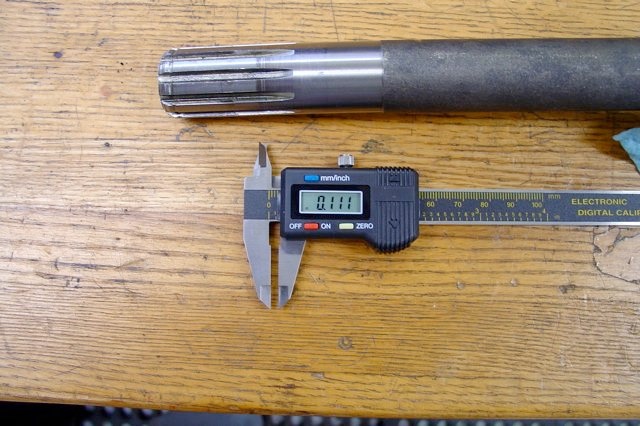
Photo of worn shaft spline

Photo of unworn portion, for comparison. Note this heavily worn shaft has more than 0.020" of wear in the splines. This not only reduces the width (strength) of each spline, it also creates a sharp stress riser right at the most highly loaded point on the shaft. It's no wonder they break.
- Weak material (pre '67 shafts, "ATA" part numbers, used only EN7, but from '67 / 1275cc engine, BMC adopted EN17. Identify later shafts by a groove machined at the end of the differential splines. Steel wheels use BTA806, wire wheels use BTA 807. For reference, BTA 939 and 940 were factory competition shafts.
Photo of EN17 groove (note the groove, about 1/4" from the end of the splines).
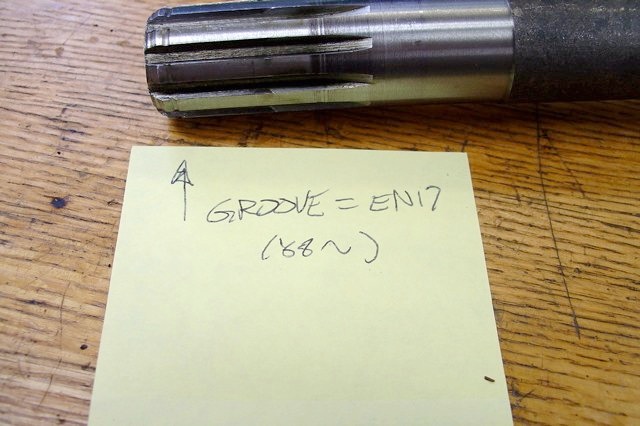
- This photo also shows well the spline wear mentioned above, just above the "oo" in "groove".
- Half shafts swapped R x L (reversing the loading reverses the twist in the material and could lead to failure).
- Double bearings have been used in an attempt to increase shaft life, especially for racing, but some have had sealing issues with them, and some racers say they still use stock bearings, without ever breaking a shaft. Growler's treatment (below) should be effective to minimize stress in the area where most fail (near the diff).
- Peter May makes EN24 shafts.
- Frontline makes EN40B nitrided shafts. Peter May says EN40B is too hard/brittle, and says "EN24 provides the best balance of strength and toughness".
- Both are about double the cost of new, stock shafts.
- When buying half shafts, or replacing the whole rear end, note that wire wheel axle housings are 1" narrower than steel wheel units, and have accordingly different length half shafts.
- Growlerize the shafts to minimize both the original stress riser where the spline cut ends, and also from the wear caused by the edge of the differential gear mentioned above. Growlerizing (named for the screen name of Grant Bowyer, the Kiwi machinist on the MG Enthusiast BBS / UK who brought it to wider attention) means to cut down the diameter of the shaft to the root diameter of the splines, so the land between the splines stick "out", rather than the splines themselves sticking "in":
- Start the cut 1" from the end of the shaft (so that the very ends of the differential splines are over air, not against the face of the splines), and provide a generous radius at the end of the splines (this photo shows too sharp a transition, a big radius would be better). Continue the root diameter for 4", then gradually taper over 6" back to the original diameter. Deburr and then shot peen (like is done with a connecting rod). Why does this work? The shaft itself is plenty strong enough to handle the engine torque, so reducing its diameter near the diff, although it gives up some torsional stiffness, is offset by the benefit gained by avoiding cracks at those two eliminated stress risers: the sharp corners at the end of the spline cuts, and where the diff splines end.
- Before doing anything with a shaft, have it crack tested first (no sense wasting time with a bum part). At that time, it is also a good idea to have the shaft stress relieved (before machining), for further resistance to possible cracking.
Half shaft history:
- Frogeye = 2A7085 (? material)
- 1098 era = ATA 501 (EN7 material)
- 1968 ~ = BTA 806 (disc wheel) / -807 (wire wheel), (EN17 material, with Identifying groove on the inboard end)