
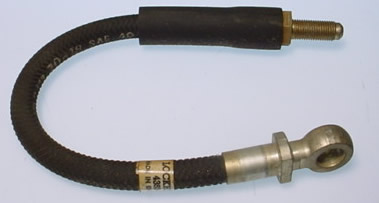
Hoses do fail from time to time for a number of reasons. Hoses are easy to replace and the front ones on disc brake cars look like the one below (with the possible exception of Donald Healey Motor co disc brake kits on very early cars). At the top right of the picture we see a threaded fitting which goes through a hose retainer welded to the car's inner fender, and right below it in the picture is a banjo fitting which connects to the brake caliper.
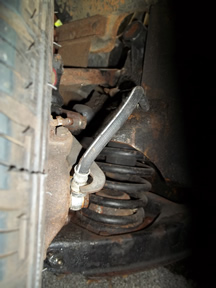 Begin by making sure the steering column is unlocked so that you can turn the steering wheel in the direction of the caliper you will be working on first. This makes it easier to access. Jack up the car if you like. Taking the wheel off is recommended but not entirely necessary.
Next loosen the banjo bolt on the caliper to disconnect the brake hose from the caliper. There is a copper gasket on each side of this fitting and the outside gasket (between the bolt and fitting) has a larger internal diameter than the inside gasket (between the fitting and the caliper). Copper hardens when "worked" or bent back and forth, squished, reshaped etc. It is possible to reuse the gaskets if they can be suficciantly annealed but the gaskets are so inexpensive they should be ordered along with the new brake hoses.
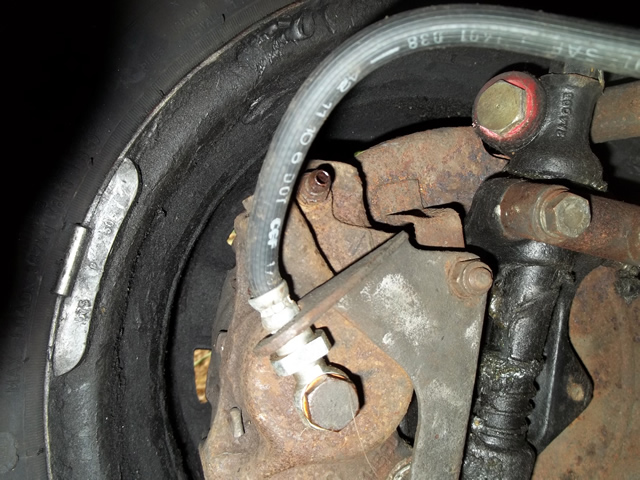
In the photo above we see that there is in fact a lock plate preventing the hose from rotating around the banjo bolt and thereby loosening it (which would result in complete failure of the front brakes). At first glance it may appear that it is necessary to remove this plate to replace the hose. However, it is simpler to pull the banjo downward so that the lockplate is touching the rubber portion of the hose. Then you can slide it out of the lockplate with a little rotation.
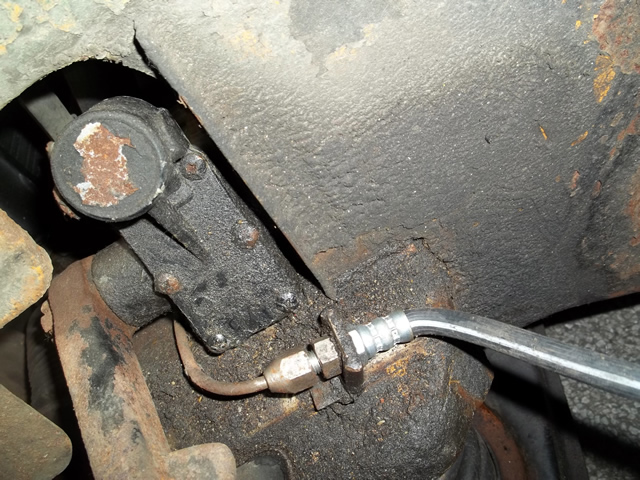
Next use a flare wrench to disconnect the brake line from the brake hose. The hose itself should be held in place with a nut on one side of the hose retainer and the hose on the other as shown below. The nut should always be on the same side of the retainer as the brake line as shown.
Installation is simply the reverse proceedure as above. Once thats accomplished it will of course be neccesary to bleed the brakes