
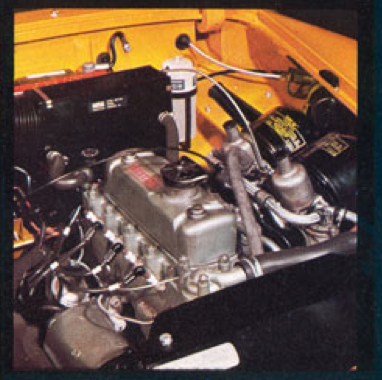
On some motors the tube pointed to the left side of the car. This was connected to a hose that connected it to the forward air cleaner. It was part of how the crankcase was ventillated. Fumes would travel up the pushrod bores into the valve cover and then get sucked into the forward carb (again thats just a part of it, there was another vent on a tappet chest cover on the 948 and 1098 (10CG engines only). In addition, a vent pipe on teh front tappet chest cover extended downward and ended in a slanted cut tip that opand more to the rear. the idea was that at speed a vacuum would be created to suck aditional fumes out of the cranckase. This is shown in the included image from the 1964 mg midget brochure. These used unvented caps. Both metal and plastic ones were used on this valve cover (depending on year).

When the Mk II Midget and Mk III Sprite were released, the 1098cc engine was revised in a number of ways including the breather system. A sealed breather system was adopted that employed an oil separator connected to a PCV valve that sat on top of the center of the inteake manifold. the oil separator was located on the front tappet chest cover. The tube on the valve cover was deleted, and a vented cap was used. This was the 10CC engine.
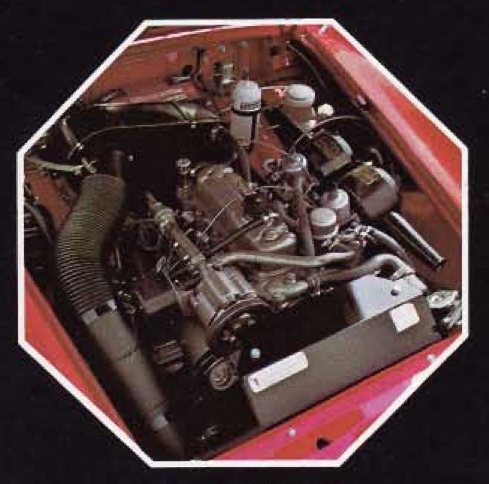
In 1967 the 1275cc engine was introduced in the midget Mk III and Sprite Mk IV. This engine block did not have a provision for removable tappet chest covers. This meant that the oil separator had to be relocated and it was moved to the timing cover at the front of the engine. The oil separator on the 1275cc engines was initially connected to the intake manifold via a PCV but this was later illiminated and the connection was made to both carbs via a brass vent tube in each. Of all the 12755cc engines in spridgets, only the 12CC, 12CD, 12CE, 12V/586F, 12V/586F, and 12V/778F engines used valve covers without vent pipes. In other words, this was only 1967-1970 for the US market, but this setup was used much longer in other markets. See image below from the 1970 MG Midget brochure.
Later British Leyland added a carbon cannister on North American controlled 12CJ, 12V/587Z, and 12V/671Z engines to trap fumes from the gas tank, and the tube returned. This time it was used to draw fumes out of the carbon cannister. Since the carbon cannister was on the right side of the car, the vent now pointed to the right.
If your car has a timing cover with an oil separator, you probibly don't need the tube on the valve cover. You can just hook that up to the intake manifold via a pcv or the two carbs via a y connector if you have the vented carbs. Just use a vented cap. This is why some the modern ribbed aluminum valve covers usually don't have a vent pipe.